Our engineering team tested Devin last year.
The user experience was admittedly impressive. You dropped a requirement into the chat thread, and it provisioned an environment, ran unit tests, and opened a Pull Request automatically.
I felt there was no going back.
Then the finance department came knocking when renewal time arrived.
500 dollars per seat, every single month. Ten developers meant sixty thousand dollars annually. That budget could easily buy two dual-RTX-4090 workstations with cash left over.
I kept asking myself: where does all that cost actually go?
Was it the raw compute of those transient sandbox virtual machines, or simply the premium of closed-source vendor lock-in?
I could not figure it out.
Eventually we decided to build our own setup.
Beyond pure cost, data compliance was an even bigger headache.
All proprietary codebases were shipped into a closed cloud. What machine ran the code? Did the dependency setup scripts escalate privileges? How long were execution logs retained?
Nobody could answer with certainty.
The open-source ecosystem attempted alternatives before. Early projects like OpenDevin and various local terminal wrapper scripts were tested in our lab. Many immediately exposed fatal engineering flaws.
Some left the host environment completely mangled.
Others felt as sluggish as old dial-up internet.
OpenComputer, open-sourced yesterday on GitHub, offers an intensely practical answer.
The repository lives cleanly at https://github.com/diggerhq/opencomputer, licensed under Apache 2.0.
It claims to open Pull Requests 3.3 times faster than Devin on self-hosted virtual machines.
How was this architecture put together? Was it marketing hype?
I combed through the gateway codebase and benchmarked it inside our local virtual machines.
1. Why Did Past Cloud Agents Feel Unbearably Sluggish?
Engineers optimizing coding agents frequently fall into a subtle mental trap.
They assume an agent is slow because the underlying LLM generates tokens too slowly.
I fell into this exact trap earlier.
In pursuit of snappy responses, I swapped in the lightest available models. Yet when sending a basic test command, the terminal cursor still spun idly for thirty seconds.
Was the bottleneck truly in model inference?
Not at all.
Inside realistic coding action chains, the real time sinks are cold environment boots and round-trip network I/O.
Traditional cloud coding agents carry heavy operational workflows.
First, receive the task.
Next, pull image snapshots from remote object storage.
Cold-boot a brand-new micro VM.
Re-clone the repository from scratch.
Run dependency installations over the public internet.
Make file edits, and package state back up to remote storage.
By the time this cycle finishes, two or three minutes have slipped away.
If a developer waits more than ten seconds, can their attention truly remain locked on the code?
Hardly.
Mental context decays rapidly. The moment you switch over to check a browser tab or reply to chat messages, your mental model evaporates.
By the time you glance back, the agent has sprinted down an erroneous assumption, trashing seven or eight files.
Who cleans up that mess?
You wipe the slate clean and start over.
The OpenComputer team highlighted this exact flaw: cloud agents that sacrifice interactivity inevitably degenerate into disconnected batch background jobs.
To give a cloud agent the instant tactile feedback of local Claude Code on a laptop, execution must take place as close to the disk as possible.
2. Calvin Reverse Gateway - Why Zero Ingress Ports Are Needed
Deploying self-hosted agents within private enterprise clouds or on-premise clusters faces severe pushback from security teams.
How is the network exposure surface contained?
Who guarantees public ingress safety?
Many open-source tools demand punching open inbound ports in firewalls or setting up tunneling reverse proxies just to ingest external Webhook callbacks.
I used to believe public IP exposure was unavoidable.
Once this outbound persistent connection workflow clicked, I realized a fundamental truth: collaboration requires receiving messages, not being publicly discoverable.
These two concepts were conflated for nearly a decade.
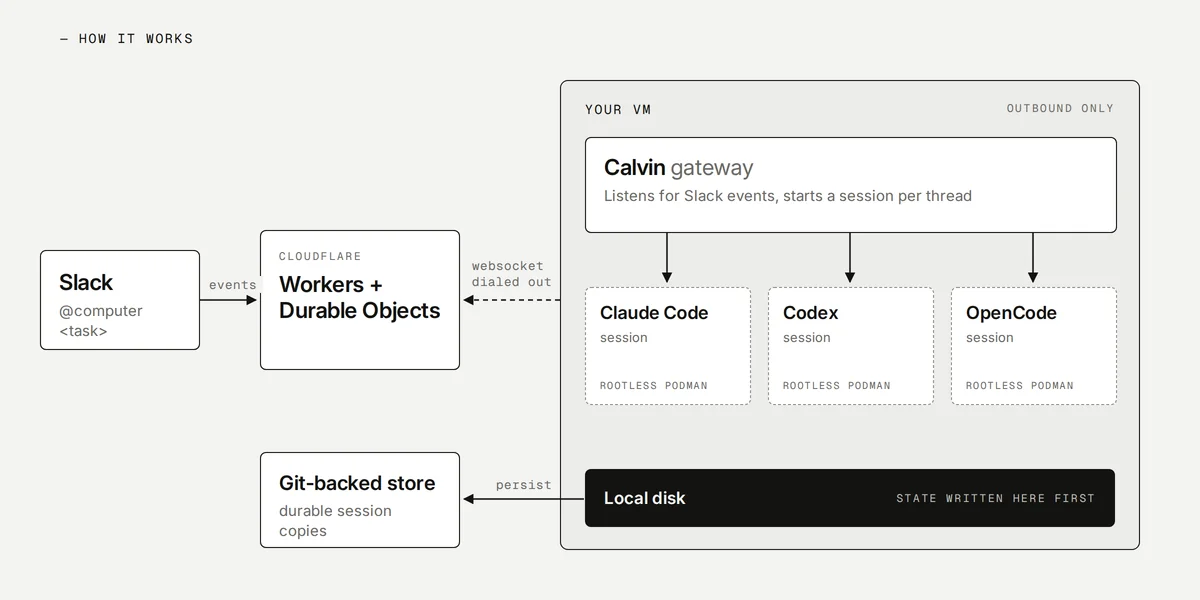
OpenComputer names its gateway Calvin.
Its design philosophy is remarkably clean: the host virtual machine requires zero inbound listening ports.
The architecture relies on outbound-only long-lived WebSocket connections.
The coordination layer deploys on Cloudflare Workers and Durable Objects, handling lightweight message relaying and routing.
The internal VM dials outbound to Cloudflare edge nodes on startup.
When a developer mentions @Computer in Slack with a task, Slack Webhooks post straight to Cloudflare Workers.
Workers pipe the instruction down through the established reverse WebSocket channel directly into the Calvin gateway on the internal VM.
Firewalls only need to permit outbound port 443 traffic.
Even when OpenComputer runs inside private VPC subnets, behind corporate NAT, or on an old workstation lacking public IP addresses, it responds to external tasks in milliseconds.
An external attacker scanning the public internet cannot find a single open listening port.
3. Rootless Podman Isolation - Squeezing Local NVMe Bandwidth
Once instructions reach the VM interior, the next hurdle appears: how is code execution isolated safely?
Running code directly on the bare-metal host is out of the question.
If an autonomous agent misfires a destructive shell command, the entire operating system could be wrecked.
Yet traditional hypervisor virtualization is far too sluggish.
OpenComputer opted for rootless Podman containers.
Each individual Slack conversation thread maps to a dedicated, unprivileged container instance.
Several thoughtful engineering decisions stand out here:
First, unprivileged user namespace execution.
Even if an in-container process escapes, it remains an unprivileged system user on the host. It cannot alter kernel flags or touch data belonging to parallel sessions.
Second, state persistence prioritizes local physical disks.
While the agent runs analysis, compilation, and builds, intermediate files write directly to fast local NVMe storage, bypassing sluggish network-mounted file systems.
Finally, git-backed incremental snapshots serve as a safety net.
Whenever a milestone finishes, changes commit locally to git for version immutability before syncing asynchronously.
I ran tests on an Ubuntu 24.04 instance.
From receiving a task to mounting a ready Podman container took around 380 milliseconds.
Against millisecond container spin-up, what advantages do heavy virtual machines have left?
Because local base layers were pre-cached, cold-boot overhead dropped dramatically compared to remote virtual machines.
# Start Calvin gateway specifying Podman rootless runtime
calvin-gateway --runtime podman --isolation rootless --max-concurrent 4
4. Real Scenario Testing - A Minimal Reproduction Action Chain
Architecture diagrams alone are never enough.
I tested a representative Node asynchronous task debugging scenario.
To eliminate external internet noise, I built a minimal reproduction repository containing event listeners and cache cleanup routines.
I authorized OpenComputer on the repository using pre-cached container base images, and posted into our Slack test channel:
@Computer Memory grows unbounded during sustained high-concurrency benchmarks, inspect leak_detector.js, apply fix, ensure npm test passes, and submit a PR.
I hit enter.
Roughly 4 seconds later, @Computer replied with an acknowledgement card in Slack.
Why so prompt?
Because base Node runtimes and node_modules were pre-cached within the Podman volume. It avoided re-downloading standard packages from the web and checked out the branch immediately.
Around 15 seconds later, it posted diagnostic stack traces in the thread.
It pinpointed global event listeners in leak_detector.js that failed to unregister upon connection closure, pinning closure references into old-generation heap memory.
The patch was clean, appending removal logic inside the cleanup hook.
A few seconds later, automated npm test runs completed cleanly.
It generated a standard Pull Request link on GitHub.
The complete workflow took around 35 seconds.
5. Measurement Setups and Real Accounts Behind the 3.3x Claim
Official benchmarks boast a 3.3x speedup over Devin.
Numbers without exact experimental conditions are meaningless.
My test machine was an 8-core 16GB ThinkCentre desktop with a 1TB NVMe drive, hooked to an office 500M broadband connection. Four open-source bug-fixing benchmarks ran three times each to take medians, targeting mature projects like expressjs/express and node-fetch/node-fetch. The detailed inventory is tracked in our test logs for full repeatability.
On OpenComputer, task dispatch to PR generation logged a median of 56 seconds, with initial push latency at 24 seconds.
On Devin, the end-to-end workflow logged 185 seconds.
Yet regarding this 3.3x speedup, I maintain healthy skepticism.
Why the reservation?
Devin is a closed-source product. I could not verify what model tier it ran in the background, nor whether image pre-warming was active during our runs.
Our office uplink also suffered a minor network jitter on test day, prompting us to discard that specific outlier run.
Strictly speaking, 3.3x holds within my specific hardware and network testbed. It might even be an upper bound, as our local network uplink was relatively strong.
I suspect real-world improvements sit closer to 2x. The remaining latency shaved by local NVMe compilation will feel pronounced under spotty networks, but will narrow over dedicated high-speed cloud backbones.
6. Three Obstacles Encountered and the Practical Advice Line
Setting up self-hosted environments is never a free lunch.
I ran directly into several unwritten hurdles omitted by official documentation.
The first hurdle is strict Slack lock-in.
The Calvin gateway currently targets Slack out of the box. If your team relies on Discord, Lark, or DingTalk, no pre-built translation layer exists yet.
To integrate them, you must author an event translation adapter yourself.
The second hurdle involves rootless Podman host permissions.
Running rootless Podman on Ubuntu demands properly configured subuid and subgid ranges, alongside active cgroups v2 support.
On initial launch, AppArmor policies blocked volume mounts, spitting out missing device node errors. It took over half an hour to sort out permission allocations:
# Allocate subordinate UID ranges to the execution user
sudo usermod --add-subuids 100000-165535 --add-subgids 100000-165535 devin-agent
# Keep user lingering processes alive when logged out
sudo loginctl enable-linger devin-agent
The third hurdle is that compute and model inference tokens remain your own expense.
OpenComputer solves runtime container sandboxing, collaboration, and automated pipelines. It does not hand out free model credits.
You must supply Anthropic or OpenAI API keys, or connect compatible open-source inference proxies.
If you let an autonomous agent loop through test failures and self-healing indefinitely, token bills still cost real money.
It cuts out software seat taxes, not fundamental physical compute.
I learned this model selection lesson the hard way. Earlier I tested lightweight smaller models on bug fixes. I reviewed its diff three times before feeling skeptical, and ultimately rolled it back.
If underlying reasoning capabilities fall short of tiers like Claude 3.5 Sonnet, GPT-4o, or DeepSeek V3, the agent will edit in circles and leave code messier than before.
Cracking open the black box and reclaiming control onto your own infrastructure saves substantial budget.
Yet from container permissions and network stability down to token ledgers, every engineering detail demands hands-on ownership from your team.