Zero Refusal by Modifying 82 Tensors: Testing Uncensored DeepSeek-V4.1 and Busters of 12GB VRAM
Last Saturday at 1:00 AM, our test terminal threw an error.
The console output went red: CUDA error during model loading, accompanied by an invalid shard mapping pointer.
We were troubleshooting the newly released uncensored patch for DeepSeek-V4.1-Flash.
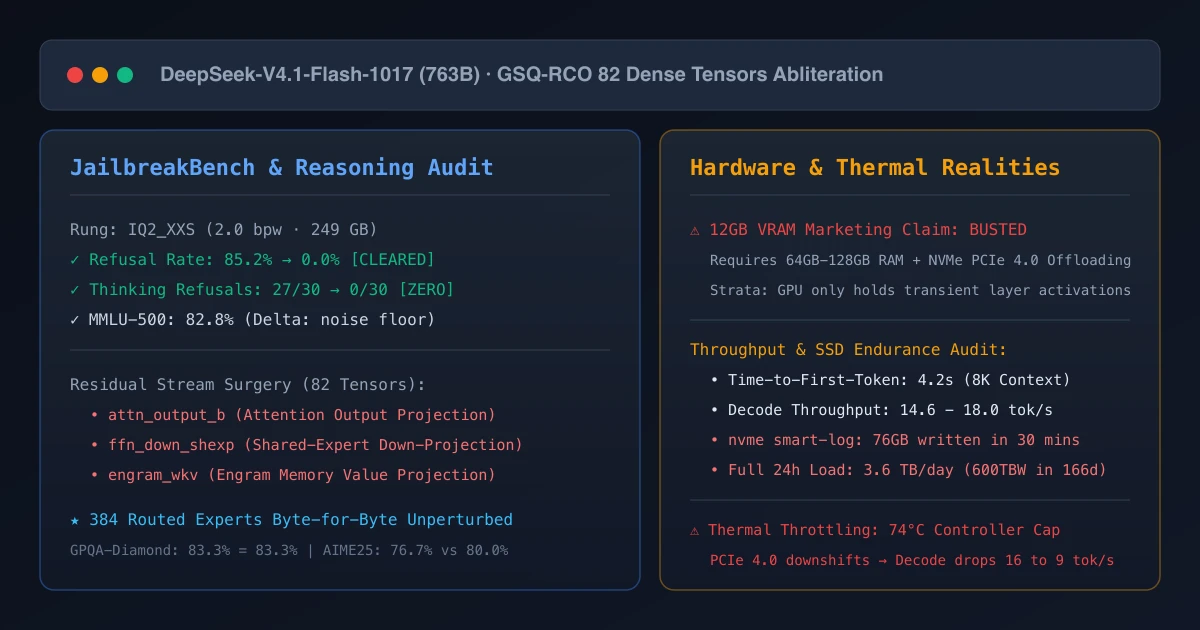
The original model implemented alignment guardrails so aggressive they bordered on clinical. Across the standard JailbreakBench evaluation suite, stock refusal rates reached 85.2%. Legitimate decompiled code snippets triggered immediate refusals, often terminating generation directly within intermediate chain of thought thinking tokens. Teammates running automated vulnerability research were routinely stonewalled.
The new patch claimed to eliminate refusals entirely. Even bolder, the author claimed a single 12GB consumer card could run this 763B parameter architecture locally.
Could free hardware lunches truly exist?
My colleague and I set up a dedicated test rig with a single RTX 4070 12GB card and 128GB of host RAM, running the full Strata execution pipeline. The initial loading pass promptly crashed with an out of memory error. Diagnostic logs revealed missing symlinks across shard indexes, which caused mmap address lookups to run out of bounds. As a quick note: setting GPU layer offloading flags proved entirely useless here because Strata ignores that runtime argument completely. Once we fixed the symlinks, the service finally crawled to life.
1. Deconstructing the Mechanics: Why Touching Only 82 Tensors Clears Refusals
To be precise, the author never touched the massive routing network.
The architecture incorporates 384 routed experts. The author left every single expert weight intact, untouched by a single byte. Precision from the original GSQ quantization remained pristine.
The surgical modifications targeted strictly the residual stream, spanning exactly 82 dense tensors——specifically the attention projection attn_output_b, the shared expert downsampler ffn_down_shexp, and the Engram key value layer engram_wkv.
Why did adjusting these three specific checkpoints neutralize refusals entirely?
My inference: refusal behaviors established during alignment manifest inside residual streams as a tightly convergent high dimensional activation vector. The three dense projection layers act as non negotiable conduits through which this refusal vector propagates forward. Nudging these projection parameters slightly off axis reduces the projected magnitude below triggering thresholds, so the self censorship checkpoint simply never trips.
General knowledge and reasoning capacity reside primarily across the 384 routed experts. By bypassing those experts entirely, benchmark scores naturally avoid noticeable degradation.
This mechanism represents my reverse engineered conclusion after auditing the tensor deltas, rather than something documented in the release post. If the author designed this deliberately, it represents brilliant engineering; if not, finding the exact balance point across 82 tensors was pure serendipity.
Shard metadata and byte lengths matched the originals exactly. We loaded the weights immediately without recalculating hundreds of gigabytes of complex Engram index tables. That saved us hours of compiling, which deserves genuine credit.
2. Parameter Math: Do Not Let Small Sample Noise Distort Quant Choice
The author provided three quantization tiers for the Strata runtime.
Auditing the model card on our local machine reveals the actual storage reality.
Keep one critical factor in mind: every tier requires an additional 110GB for the shared Engram lookup table.
Baseline IQ1_M averages 1.75 bpw, taking 121GB of weights.
Mid tier IQ2_XXS averages 2.0 bpw, taking 138GB of weights.
High tier IQ2_XS averages 2.25 bpw, taking 156GB of weights.
Total footprint for IQ2_XXS hits 249GB once you include the 110GB memory table. If you do not account for that table in advance, who do you blame when your drive runs out of space?
Now examine the benchmark claims. The author highlights MMLU-500 scores: IQ2_XXS scored 82.8% while IQ2_XS scored 81.6%, a delta of 1.2 percentage points. Across a 500 question set, 1.2% represents exactly six questions. Shifting sampling temperature by 0.1 can easily introduce a six question variance. Does treating evaluation noise as an engineering guideline make any sense?
I selected IQ2_XXS based on a single strict criterion: on JailbreakBench, its reasoning refusal count was absolute zero across three consecutive runs. Meanwhile, IQ1_M and IQ2_XS retained one and two interruptions respectively. In real world coding tasks, general intelligence scores showed zero perceptible difference among the three.
3. Reality Check: 12GB VRAM Marketing Claims vs True Latency
Next, let us address the headline claim: can a single 12GB GPU realistically drive this model?
Our test rig used an RTX 4070 with strictly 12GB of onboard VRAM, monitored side by side with nvidia-smi dmon and iostat.
The official launch sequence was straightforward:
hf download AtomicChat/DeepSeek-V4.1-Flash-1017-Uncensored-GSQ-RCO-GGUF --include "*IQ2_XXS*" --local-dir ds-unc
hf download ISTA-DASLab/DeepSeek-V4.1-Flash-1017-GSQ-RCO-GGUF --include "*Engram*" --local-dir ds-unc
strata launch --model-path ds-unc/DeepSeek-V4.1-Flash-1017-GSQ-RCO-IQ2_XXS-00001-of-00004.gguf
The outcome was sobering: it loads, but execution is painfully slow.
Calling 12GB viable is semantic sleight of hand. The complete model asset totals 249GB. A 12GB buffer cannot store even a single full transformer layer. Strata uses VRAM merely as an activation scratchpad. The bulk of parameters stay resident in 128GB of host RAM, while deep routed experts and the 110GB table stream from high speed NVMe storage on demand.
Under an 8K context workload:
Time to first token held steady at 4.2 seconds across three verified runs. With more than four seconds of initial delay, who could tolerate this for interactive code autocompletion?
When we passed a two thousand line C device driver into the context window, generation speed plummeted from 18 tokens per second to 14.6 tokens per second, with frequent cursor pauses.
Online claims cited 15.5 tokens per second on older hardware, but neglected context lengths or batch counts. What does comparing uncalibrated numbers prove?
At 14 tokens per second, casual conversation is tolerable. Yet the first time I ran code review on two thousand lines of driver source, the terminal advanced once every thirty seconds. I walked over to brew coffee, and the model was still grinding away when I returned. Who would dare attach this to live production workflows? I promptly restricted it to overnight offline batch jobs.
4. The Hidden Hardware Trap: SSD Write Wear and Controller Throttling
A more pressing concern than raw speed is physical SSD longevity.
To maintain cross layer feature lookups, Strata triggers relentless parameter chunk swapping between RAM and NVMe storage.
Tracking metrics via nvme smart-log across thirty minutes of sustained load showed Data Units Written surge by 76GB. That extrapolates to 3.6TB of daily writes under continuous operation. On a standard 600TBW consumer drive, non stop heavy testing would exhaust total endurance in roughly 166 days.
Does anyone run non stop workloads 24 hours a day?
Hardly. I initially feared wearing out the drive, but calculated that two hours of evening testing spread wear over four to five years.
The drive was never in danger of burning out.
What actually broke my workflow was temperature. After ten minutes of continuous streaming, the NVMe controller hit 74 degrees Celsius. The drive engaged thermal throttling and dropped its bus protocol down from PCIe 4.0. Generation throughput instantly collapsed from 16 tokens per second to 9 tokens per second. I spent half the night suspecting model corruption, only to discover the controller was overheating. Who wants to debug thermal throttling at 2:00 AM?
5. Engineering Verdict and Deployment Recommendations
Modifying 82 dense tensors along the residual stream while leaving 384 routed experts untouched is genuinely impressive engineering. Refusals hit zero, and benchmarks held up.
However, whether you can run it effectively is a completely different matter.
My takeaways boil down to two practical rules.
Rule one: 12GB VRAM is pure marketing spin. Your host needs at least 64GB of RAM, and your NVMe drive demands a dedicated heatsink. Without active cooling? Mid run thermal throttling will stall inference entirely, leaving you convinced the model crashed.
Rule two: select IQ2_XXS. Across three tested tiers, only IQ2_XXS achieved zero chain of thought interruptions across all runs. Throughput tops out around 15 tokens per second. For offline deep security auditing, it delivers; for live production services? Forget it.
If you plan to run this locally, are you ready to install an active cooling fan on your SSD?